Wednesday, July 26, 2017

On Murderers and Babysitters (Part Three)

There is a postscript to this story that explains why I added the word "babysitter" to the title of these blogs.

I had maintained contact with Ike along with his dedicated lawyer,  Aviva Futorian. I remember one visit at Pontiac when Ike was led out in chains to talk with us through glass. He was intensely aware of his “slave-like” status and told me he was deeply embarrassed. He didn’t want to be seen in chains and we found discussions labored and the visit didn’t last long. We did talk about my six year old son Jess.  Ike’s art gave meaning to his life and my little Jess had artistic talent.  Ike had sent Jess a picture and Jess drew one for him along with a few words that a six year old could muster to someone in such an incomprehensible situation.

Ike's letter to my son, Jess
It was at this Pontiac visit that Ike told me that he would not be able to send any more pictures to Jess since his pencils had been taken away from him as possible “weapons” and he was unable to draw with the crude colorless implements they allowed him to have.  

As someone who had killed a prison official Ike had to be constantly aware of threats to his life by correctional officers. His treatment by guards was hostile and at times cruel.  Taking away his colored pencils seemed to me mainly about breaking his spirit.

Things changed a few years later. As Ike sat on death row, Illinois Governor George Ryan became aware of the torture of black gang members by Chicago Police Commander Jon Burge. Several of these men who had been sentenced to death were exonerated by DNA evidence. Ryan ordered hearings to be held on every inmate on death row to allow testimony, mainly from victims, on whether the Governor should grant clemency.  

Two motivations drove me to show up to testify on Ike’s behalf. The nature of his trial had convinced me that some ways had to be found to counter the reign of stereotypes and demonization of gang trials.  And second, my own interactions with him had taught me Ike was not an evil monster, despite having committed evil acts. He was more than one thing and there was a depth of humanity to a man who interacted so sensitively with my son. I had found Ike was likeable and I believed he could be redeemed and rehabilitated.

I showed up at the state office building where the hearing was to be held and entered a room packed with prison guards and officials. They were lining up to testify and filled with hate. One mid level corrections bureaucrat said “Easley must be killed before he kills again.” The testimony went on for a couple of hours before the chair introduced Ike’s new appointed attorney who was visibly intimidated by the show of force by dozens of armed correctional officials. 

His comments are a good example of what passes for a legal defense in many gang trials. He was appointed to make the case for clemency.  I’ll repeat all of his comments verbatim. He said “Here is Professor Hagedorn who will say something on Ike’s behalf.”  That was it, his whole case. 

Everyone’s eyes glared at me as I took the stand. My Oppositional Defiant Disorder kicked in and I briefly summarized the unfairness of Ike’s trial. But my main argument was that this man, who was labeled a monster who had to be killed, was a human being with much good in him. I talked about his abused childhood and feelings of abandonment. I recalled his peacemaking actions in the prison. But I mainly talked about his exchanging letters and art work with my young son. Why would you kill someone who could show such feelings of empathy? Why not treat his emotional distress and let him channel his anger into art? 

There were some jeers but mostly angry stares implying “how dare you defend this monster.”  But the room was stunned when I concluded that if Ike Easley could be paroled and given another chance at life I would welcome him as a babysitter for my son.  I remember a couple of journalists running out of the room to phone in the story and a few newspapers reported my comments. The correctional officials just looked at me in disbelief. My testimony made no sense to them whatsoever. I lived in a different world than they did. Some frames never interact.

Ike only was granted clemency since Gov. Ryan commuted sentences for everyone on death row.  If you haven’t read Ryan’s remarkable clemency statement, it can be found here. If Ryan had looked at clemency case by case I’m quite sure he would have succumbed to pressures by the correctional bureaucracy and Ike would not have been spared.

It was Ike Easley’s trial and humanity that put me on the path to confront stereotypes and demonization at criminal trials.  To me justice in gang trials means two things. First jurors should decide cases and sentences on evidence not on fear and false generalizations. Second gang members are human beings.  Doing evil doesn’t mean you are evil. My empathy for the families of victims does not stop my feeling empathy for a gang member who killed. Another word for “murderer,” after all,  is “human being.”  And I know that is hard for most people to accept.

Tuesday, July 25, 2017

On Murderers and Babysitters (Part Two)


Defendant also attached to his post-conviction petition a report by John Hagedorn, who is a sociologist and an expert on street gangs. In his report, he conceded that the gang-related evidence may not have changed the outcome of the guilt phase of the trial. However, he opined that the gang-related evidence "exercised considerable influence on the jury in the penalty phase of the trial. In other words, if the gang issue had not been such a major focus of the trial, I believe the jury would have been substantially less likely to ask for the death penalty.”

We disagree…

People v. Easley.  Supreme Court of Illinois.·148 Ill.2d 281 (Ill. 1992)


My involvement with Ike Easley’s appeals led me to immerse myself in studying the power of stereotypes.   One key lesson I’ve learned from my studies in social cognition is that a jury already has an image of a gang member in mind before a trial starts, what is called a prototype. This prototype is typically of a gang member as a “savage beast” and left unchecked, juries will be receptive to evidence that confirms their stereotype and reject any evidence that contradicts it.  My expert witness work is aimed at helping jurors question their stereotypes so they are more able to accept "discrepant information" or evidence that doesn't fit with pre-existing images. 

We think in metaphors which according to Winter “are neither true nor false, but have consequences, perceptions, inferences, and actions.”  This means if a gang member is like a savage beast then a jury will believe he is likely to have killed "like an animal" as alleged.  The savage beast metaphor includes the related notion that such wild animals need to be “put down.” Stereotypes can kill.

You probably guessed Ike's jury was all-white. But this was not by accident. The prosecutor excused every black potential juror with the argument that since they lived in black communities where black gangs also resided,  jurors were likely to be intimidated by the threat of gang retaliation. Despite criticism of this tack by the Seventh Circuit Ike did not face a jury of his peers.

But it gets worse, much worse. Because of the intense publicity in the area around Pontiac, Ike’s trial was moved to Will County and the city of Joliet. In the week before the trial, three El Rukn gang members had murdered a Joliet prison guard and newspaper accounts of this crime circulated among Ike’s jurors. Ike remembered the judge making comments about the El Rukn murder during the trial. If Ike's case evoked a frame of gang members as savage beasts who kill prison guards, the environment in Joliet at the time strongly reinforced that frame.

Pontiac Correctional Center
The prosecutor had been prohibited by the court to allege the killing was the result of a gang conspiracy. The court found there was no evidence of such a conspiracy and this was affirmed by the Illinois Supreme Court on appeal. Despite this admonition, the prosecutor claimed in his opening statement, during trial, and at closing that the killing was ordered by the Black Gangster Disciples. The image was the gang letting the beast Ike Easley out of his cage and telling him to “kill.” The Supreme Court ruled that while the allegation of a conspiracy was “improper” Ike “suffered no prejudice therefrom.” I disagreed.

Let me tell you about killing. Randall Collins says violence is hard. While there are “hit men” who are cold and mechanical about killing, most murder is done in passion and with adrenaline flowing. The court acknowledged after Ike was detained he yelled out ““all you honkey motherfuckers want is a nigger donkey to pin this case on, and I am your donkey, I am your killer.”  Ike denied to me that any gang meeting had ordered the killing.   In one of the most emotional exchanges of my life Ike talked about the “uncontrollable” urges that streamed over him once the violence had begun and he and Taylor fought for their lives. Afterwards Ike said he blacked out and  “I threw up like a motherfucker.”  These are emotions, triggered by an extreme event — the killing of Ike's best friend and revulsion toward his own violent act.  Therapists say people like Ike can be responsive to long term treatment.  To me Ike's emotional response to his violence was an indication of his humanity and an example of how killing violates deeply held norms.

The final “nail in the coffin” in enflaming the fears and prejudices of the jury was not mentioned in any of the court decisions. I pointed out in my statement that a “moral panic” atmosphere surrounded the trial. My field notes capture the pièce de résistance that inhibited reason from deciding this case.

Finally, in my mind, the most damaging event was the manner in which the jury was protected during trial. Defense attorneys have told me that sharpshooters were deployed to protect the jurors.   When the jurors asked why there were sharpshooters, they were told something like that "the gang may want to kill jurors." It is hard to underestimate the impact this must have made on the jury. 

It is not easy to use System 2 logical reasoning when you are in a state of fear. “Terror Management Theory” finds that people, e.g. jurors, when faced with threats to their own mortality are more likely to rely on stereotypes and not think analytically.  Duh. What do you think the jury was feeling while being told Ike’s gang might kill them? 

Consider the scene: An all-white jury, in a setting that recently witnessed a similar murder of a local guard by gang members, listening to a prosecutor who improperly alleged a gang conspiracy and then had the deliberating jurors surrounded by sharpshooters protecting them from being assassinated by the gang.  I don't care what the jury decided, it was not based on a reasoned judgement of Ike Easley’s potential for rehabilitation or any dispassionate consideration of justice. Fear, not facts, drove that jury to their fatal decision and sent me on my path of studying the power of stereotypes in court.

One final chapter remains: the clemency hearings and the commutation of Ike's death sentence.

Cohen, Stanley. 1972. Moral panics and folk devils. London: MacGibbon & Kee.

Collins, Randall. 2008. Violence : a micro-sociological theory. Princeton: Princeton University Press.

Greenberg, Jeff, Sheldon Solomon, Mitchell Veeder, Tom Pyszczynski, Abram Rosenblatt, Shari Kirkland, Deborah Lyon. 1990. "Evidence for Terror Management Theory II: The Effects of Mortality Salience on Reactions to Those Who Threaten or Bolster the Cultural Worldview." Journal of Personality and Social Psychology 58(2):308-18.


Maruna, Shadd. 2001. Making Good:  How Ex-Convicts Reform and Rebuild their Lives. Washington, DC: American Psychological Association.


Winter, Steven A. 2001. A Clearing in the Forest:  Law, Life, and Mind. Chicago: University of Chicago.

Monday, July 24, 2017

On Murderers and Babysitters (Part One)


As I near my 70th birthday I have been asking myself why I spend so much of my remaining time in life consulting for the defense of gang members who are charged with murder. While some may be innocent, most are guilty.  How can I justify this?

For many of the lawyers I work with defending gang members means upholding civil liberties and giving their client the best defense they can offer.  I’m not a lawyer and many cases boil down to technical disagreements and narrow applications of the law more than issues of justice. 

On the one hand, ethically, I do not believe people who kill should get away with it.  I feel empathy for offender and victim.  On the other hand I think our sentencing policy is draconian.  Incredibly, one in every five African Americans in prison today are serving life sentences and two thirds of all inmates serving life are minorities.   Human beings, even those who kill, are still human beings and I do not think they should be caged like wild animals for their natural life.  

During sentencing I try to explain gang involvement in such a way that a judge can have a bit more understanding, if not compassion.  A gang member’s life should not be reduced to a snapshot of a crime scene, but considered as one frame in a life long movie of change and maturation. I believe everyone deserves a chance at rehabilitation.

I’ve been immersed for two decades in the literatures on how we think in stereotypes,  but I began my court work not through books but experience. What directly pulled me into this field was getting to know gang members who killed and learning how their trials were conducted.  Let me introduce you to Ike Easley.

Ike Easley's current IDOC photo
Ike was one of the first expert witness cases I took and I’m afraid explaining his importance will take three blogs over the next three days.  The issue with Ike was not whether he killed: he committed not one, but two homicides. Let me walk you through his case from its beginning to the commuting of his death penalty sentence by then Gov. Ryan of Illinois. 

Ike was a severely abused child who was bullied at school. When his sister was being repeatedly struck by her boyfriend and threatened his mother,  Ike intervened. When the the abuser went for a gun, Ike shot him first.  Wolfgang calls this victim-precipitated homicide and this kind of murder is quite common. Ike reasonably argued it was self defense. He had no criminal record and was taken by utter surprise by a guilty verdict and a sentence of 20 years in prison.  Cook County Jail was also a shock, and Ike’s membership in the then Black Gangster Disciples was both a protective factor and an emotional response to what he saw as an unjust sentence.

Ike’s second killing got headlines and a high profile trial. Ike stabbed and killed Robert Taylor,  the Assistant Superintendent of Pontiac Correctional Center.   Taylor was a widely admired African American administrator and his murder sparked outrage among prison officials and prosecutors.   Ike’s trial resulted in a guilty verdict and the death penalty.  I got involved with the case through Ike’s appellate lawyer, Aviva Futorian, on a habeas petition of ineffective counsel in his original trial.  

I traveled to Menard where Ike was incarcerated and awaiting an execution date. I did not know what to expect in meeting this double murderer.  He had been transferred from Tamms, Illinois’ super max prison that was recently closed.  He was singled out in media accounts as among the “worst of the worst.”  This didn’t fit with the man I met.   I found Ike to be a gentle giant, soft spoken and an astute cultural critic. He was keenly aware of the culture of violence  promoted on TV and on the streets where he grew up. He admitted he experienced the effects of this culture personally and felt an obligation to warn youth of its dangers. In my statement to the court I compared him to troubled white kids I knew growing up in Clintonville, Wisconsin.

Magic to My Soul by Ike Easley
On my first visit we had an intense four hour conversation about what had happened on the day of his lethal assault on Taylor and exchanged personal experiences and outlooks.  Ike had never admitted to the murder and his vivid description of the incident to me was one of the most emotionally draining experiences of my life.  Ike is extremely emotional and his pent up rage contributed to both murder charges.  He also displayed a sensitive, artistic side and questioned me about my own children and life.  I'll explain the "babysitter" in the title in a later blog.  We connected on a human level in the first and subsequent meetings.

My conversations with Ike were the beginnings of my realization that gang members, like all of us, have multiple conflicting identities. While Ike had killed he also loved and at most times lived a life of peace. In prison he had often functioned as a peacemaker, breaking up fights.  For abused children like Ike who have faced unjust, racist treatment throughout their life extreme events can trigger inner violence.  This is what happened at Pontiac in 1987 as Ike snapped.

The events surrounding the murder were much more complex than presented at the trial as a cold blooded gang-ordered “hit.”  Conditions at Pontiac were described by many observers as “out of control.” Gangs were at war within the prison and weapons and drugs were everywhere. The year after Ike’s conviction, 16 guards were indicted for drug trafficking at the prison, This confirmed Ike’s sober explanation to me of how prison corruption was related to the murder.

According to Ike, various persons and factions within the prison administration were maneuvering to get their share of drug profits by allying with the Vice Lords and El Rukns against the Black Gangster Disciples. One of Ike’s best friends, Billy Jones or “Zodiac” was killed by guards and Ike and others believed his killing was part of a power play by guards and their new gang allies to seize control of the drug trade.  The guards claimed Zodiac swallowed a bag of cocaine and “accidentally” died but Ike told me he saw the assault on his best friend and became enraged.  Soon after Zodiac’s death Ike entered Taylor’s office with a “shank” and stabbed him to death. Tragically, there is no evidence Taylor was corrupt but only an available target for Ike’s out of control rage. 

While Ike’s history of abuse may be mitigating, his crime is surely deplorable. It is easy to see why any prosecutor or jury would be outraged. “Outrage” also isn’t a bad word to describe his trial as well.  In the next blog let me describe Ike’s trial in Joliet IL which to me is symbolically adjacent to Salem, MA.


Wolfgang, Martin E. 1957. "Victim Precipitated Criminal Homicide." The Journal of Criminal Law, Criminology, and  Police Science 48(1):1-11.

Monday, May 22, 2017

Priming, Racism, Brains, and Gangs

In most of my trials a young African American male is led out to the defense bench by courthouse guards. Sometimes he is handcuffed and sometimes he is clad in a faded orange jumpsuit.   But he always appears in basic black.  
Social cognition literatures call the jury’s first impression of a man with black skin in custody a prime or cue.  The cue of his black skin involuntarily brings to life in juror’s minds cultural associations of black men with violence and criminality.

Susan Fiske says “The racial schema of black people is the belief blacks are dirty and physically skilled (e.g., athletic)…as well as militant, violent, criminal, and hostile.”   
             Views of a representative  sample of the US population. 
Blacks are seen as more violent , lazier, and less intelligent than whites
 General Social Survey 2000. National Opinion Research Center
If the defendant is also claimed to be a gang member in the prosecution’s opening statement, that association is unlikely to fade away.  Mock jury studies find that the mere association of a defendant with gangs makes it more likely he will be convicted.

Black √ Male √ In custody √ Gang Member √   — four strikes are more than enough.  From the first moment of court it becomes apparent to the average juror that this kind of defendant is guilty until proven innocent.  Eisen calls this “reverse jury nullification” or when the gang issue influences a jury to convict despite evidence.

Even mention of "gang" makes a guilty verdict more likely
Once cued that the defendant is a gang member and therefore likely to be violent and probably guilty of the charges, a jury’s critical thinking or system two reasoning often shuts down.  Gilovich says:  “When examining evidence relevant to a given belief, people are inclined to see what they expect to see, and conclude what they expect to conclude.  Information that is consistent with our pre-existing beliefs is often accepted at face value, whereas evidence that contradicts them is critically scrutinized and discounted.”  In other words the jury is on the prosecution’s side unless heroic efforts are made by the defense.

In Claude Steele’s classic, Whistling Vivaldi, he describes his experience jogging as a black man in liberal Hyde Park, home of the University of Chicago. New to the area and decked out in what might look like ghetto attire of a sweat shirt and pants, he fit the dangerous black male  stereotype. He got “looks” and people went to the other side of the street. How could he signal to his fearful white neighbors that he was one of us and not one of them? He solved the problem by whistling Vivaldi’s Four Seasons as he jogged, cueing his sophisticated watchers to his having a European classical background that would be unlikely to be in the repertoire of a street thug.

It’s not so easy to whistle Vivaldi in a courtroom.

Once a jury believes the defendant is likely guilty, confirmation bias does the rest. As Michael Shermer says  “research consistently shows that once people have established what they think is the cause of an event they just observed—(in other words, they have formed a link between A and B)—they will then continue to gather information to support that causal link over other possibilities—if they can even think of alternatives once the first causal link is established, which they usually cannot.”

And sadly, its not just a matter of culture. fMRI scans indicate that the amygdala is automatically activated whenever an out group is present. Link that activation of evolutionary “danger” of the presence of outsiders to stereotypes of black men and gang members and the courtroom becomes an arena where the defense is put in a position of having to prove a black gang-related defendant is not guilty.
The fight or flight center of the brain


The power of even unconscious primes has been demonstrated through much research. Steele reports female students who were shown subliminal images of professional, competent women before a math test performed significantly better than those who were similarly shown images of women in traditional gender roles. By the way the girls primed by professional images did even better than the boys on the test. 

We don’t have many studies of what happens during juror deliberation, but Fleury-Steiner’s research on death penalty juries reveals jurors routinely dehumanized a defendant, in interviews calling one a “ beast…sociopath…evil person.”  Jurors, Fleury-Steiner found, saw themselves as “us” and the defendant as “them,” more able to condemn to death a defendant because he was defined as an out group, particularly a racial out group:  “I saw the defendant is a very typical product of the lower socioeconomic black group who grew up with no values, no ideals, no authority, no morals, no leadership, and this is come down from generation to generation….. he wasn't a white kid.”  Sentence: death.

These findings are a warning to defense attorneys who think mitigation means to paint a picture of the defendant as an abused child and the product of an unforgiving environment.  This kind of testimony can evoke sympathy, but Fleury-Steiner found that it can also reinforce stereotypes and the “us vs them” dichotomy, making the death penalty or very long sentences more likely.   

A defendant is convicted or given a long sentence not so much by the evidence itself but by how the evidence is interpreted or framed by juries and judges. That frame is guided by non rational processes that include the racial and “gang” cues that establish likely guilt in a jury’s mind. My job as an expert witness is not just about using “research not stereotypes” but counteracting dehumanizing cues by explaining the defendant’s actions in terms a jury may condemn but still understand. In other words, my job is to “whistle Vivaldi” to the jury so they can look at the defendant as one of us, not one of them. 

Yeah. That’s hard.


Eisen, Mitchell L., Brenna Dotson, and Alma Olaguez 2014. "Practitioner: Exploring the prejudicial effect of gang evidence: under what conditions will jurors ignore reasonable doubt." American University Washington College of Law Review.  Brief 41.

Fleury-Steiner, Benjamin. 2004. Jurors' stories of death : how America's death penalty invests in inequality. Ann Arbor: University of Michigan Press.

Gilovich, Thomas. 1991. How We Know it isn't So: The Fallibility of Reason in Everyday Life. New York: The Free Press.

Shermer, Michael. 2011. The Believing Brain: From Ghosts and Gods to Politics and Conspiracies---How We Construct Beliefs and Reinforce Them as Truths. New York: Henry Holt & Company.

Steele, Claude. 2010. Whistling Vivaldi : and other clues to how stereotypes affect us. New York: W.W. Norton & Company.


Monday, April 10, 2017

Winning Over the Other Side (Part 3 of 3)


Once upon a time, in a galaxy not so far away, Chicago’s Gangster Disciples invaded Mahnomen, Minnesota, a bustling “metropolis”  235 miles north of Minneapolis.  Fear tore through the northlands as the “gang frame” was imposed to explain a local homicide.

A Gangster Disciple branch had secretly formed in upper Minnesota, two men said in a  plea deal.  They claimed the murder they committed was not their fault but ordered by Timothy Shanks, the “Pharaoh” of the gang. 

The Minnesota Attorney General was so alarmed by their state being invaded by a notorious Chicago gang that they sent in a team of Minneapolis lawyers to make sure Shanks would be convicted for this heinous gang-related crime.

This trial is a successful illustration of reframing, one of George Lakoff’s key techniques on persuasion.  Lakoff’s Don’t think of an Elephant was written in the wake of George Bush’ 2000 Republican electoral victory. Lakoff argues that Democrats tried to beat the Republicans by accepting their language and their “strict father” frame of reality.  

For example Lakoff points out that when the right says “family values” they mean obedience to the rules of a “tough love” father and an absolute sense of right and wrong based in obedience to God the Father. The sanctity of unborn life is enshrined in the Bible and God and priest need to be obeyed.  Rather than talk about family values as adherence to rules, Lakoff says we should “reframe” or suggest a different understanding of family, ie. the capacity of a mother to nurture and properly care for her child and who should be able to make her own decisions about her body.  Lakoff’s books give numerous, rich examples of reframing, of getting others to see things through shared, empathetic values.

Lakoff doesn't deal at length with crime, perhaps because crime (and gangs) in a courtroom immediately and powerfully cue the strict father frame through our System 1 reasoning.  From the judge sitting on high and a prosecutor who casts moral blame,  gang-related trials reverse the presumption of innocence.  Gang members are assumed guilty and defense attorneys need to prove otherwise. It worked that way in Mahnomen.

The prosecution of Timothy Shanks began as a gang-related murder and looked hopeless from the start. The judge who appointed local attorney Peter Cannon to defend Shanks, privately told his long time friend to forget about putting up a defense. The Minnesota Attorney General’s office had vast resources and in a trial of a black gang member in an all-white Scandinavian community, conviction seemed to be guaranteed. 

Like many of my stories, the real hero is an attorney who refuses to surrender to stereotypes. Something didn’t sound right to Peter Cannon and after many phone calls looking for a “gang expert”  he finally reached me. I talked with Mr. Shanks and quickly concluded that not only was this crime not gang related but Shanks was completely innocent. Shanks was being tried by the gang frame, not by facts. The actual shooters had got off with only a couple of years sentence by claiming Timothy, the “Pharaoh" of the GDs had ordered the “hit.” The key to this trial was to persuade the judge that the crime had nothing to do with gangs. And if it had nothing to do with gangs, there was no evidence whatsoever to charge Shanks.

My first reason for thinking the gang-related charge was bogus was that there is no rank of “Pharaoh” in the Gangster Disciples. In a written affidavit and later in testimony in court I disputed the gang frame in its entirety and went through all of the evidence, giving an alternative story that explained the crime without the gang frame. By doing so i encouraged the court to use System 2 reasoning and not settle for System 1 stereotypes.

Timothy Shanks was a black man from Gary making his living on the carnival circuit in northern Minnesota. He had a faded tattoo from his youth of the GD six pointed star. Having such a tattoo I explained was not evidence of current gang membership, but  was normal for many poor black kids in the Chicago area and meant little a decade or so later.  What about his “order” to murder?  At a party the two shooters asked Shanks what they should do about money owed to them by the victim? By all accounts, Shanks, who was surrounded by several local girls, huffed “Do what you gotta do.” That was it.  No gang meetings or evidence of any other gang activities.  Just words at a party impressing a couple of young white girls.

Shanks’ murder charge, I argued, could be reduced to a desperate ploy by the shooters to cut a deal with gullible prosecutors.  My cases are filled with allegations by jail house snitches or co-defendants claiming a crime actually was gang related in order to get a favorable deal for themselves.  In this situation the two pleaders got the gang leader title wrong, but in others cases I’ve discovered “gang evidence” was completely fabricated. What is amazing is that such skimpy evidence could invoke a “gang as evil” frame that would cause prosecutors to imagine Timothy Shanks ordering a murder. This is the definition of System 1 thinking.

There was one other piece of evidence tying the carny worker to the Gangster Disciples. It was established in testimony that Shanks often used the expression “What’s up Folks.” By the time this came up in the trial things were already getting dicey for the prosecution. My reframing the crime as a ill-informed plea deal plus the rather questionable notion of gangs running wild in Mahnomen was raising doubts to the judge and even the prosecutors.  I calmly explained that “what’s up folks” is a common greeting in black communities, not necessarily gang related. If everyone who said “What’s up folks” was a gang member, I testified,  then the court ought to indict Porky Pig and his Disney folks gang. 

Well the judge had had enough. He called the Assistant Attorneys General to the bench and it was agreed to drop all charges. Peter Cannon dug into his pocket and gave Timothy bus fare back to Gary.  Justice was served, though Timothy had spent months in jail awaiting trial in what was truly a “gang frame-up.”

Lakoff gives four pieces of advice in how to win over the middle: Show Respect; Respond by Reframing; Think and Talk at the Level of Values; and Say What You Believe. In the Mahnomen courtroom I responded with reason and facts but mainly reframed the crime as having nothing to do with gangs. Rather than an actual gang hit what we had was 1. Two guys trying to avoid long prison terms; 2. The stereotype that black men + a murder means they must be in a gang; and 3. All-too-common macho talk at a party.  Shanks’ old tattoo, his saying “What’s Up Folks,” and being black in Mahnomen are flimsy evidence to prove he was a “gang leader” who called a hit.

Unlike the Tennessee judges, these prosecutors were open to my arguments when I activated a different frame. They had read People & Folks, my first book, and in cross examination I was treated with respect and I gave it back on the stand. Prosecutors aren’t always so reasonable and most of my clients are not innocent.  But the lesson is that among those who disagree with you there are some who can be won over by conscious reframing.  In blogs to come, I’ll draw on more of my cases to explain the power of stereotypes in court and relay different tactics I’ve used to combat them. 


Kahneman, Daniel. 2011. Think Fast and Slow. New York: Farrar, Strauss and Giroux.

Lakoff, George. 2004. Don't think of an elephant! : know your values and frame the debate : the essential guide for progressives. White River Junction, Vt.: Chelsea Green Pub. Co.


Monday, April 3, 2017

Winning Over the Other Side (Part 2 of 3)

There are some people you can’t win over, at least in the short term. That doesn’t mean you don’t try, but presenting the facts alone won’t cut it.
A few years ago I gave a talk at the Tennessee Judicial Conference, an annual meeting of judges. Tennessee is a death penalty state and judges there, like everywhere, are hostile to gang members who are on trial.  I made my standard presentation on stereotypes, drawing a laugh here and there at my powerpoint graphics. But otherwise the judges were silent. After a while I suspected most had stopped paying attention.  

When I finished I asked for questions and there were none….. just stares.  This same talk had received enthusiastic applause and numerous questions at a Vanderbilt University law conference the year before, but the judges hated it. Why?

Trying to figure this out I have turned away from sociology and have been exploring social cognition literatures, defined by Susan Fiske as “how ordinary people think about people and how they think they think about people.”  In the academic tradition where I was trained, there is an unstated assumption that rigorous research will produce facts that will persuade others.  I found it seldom works that way.

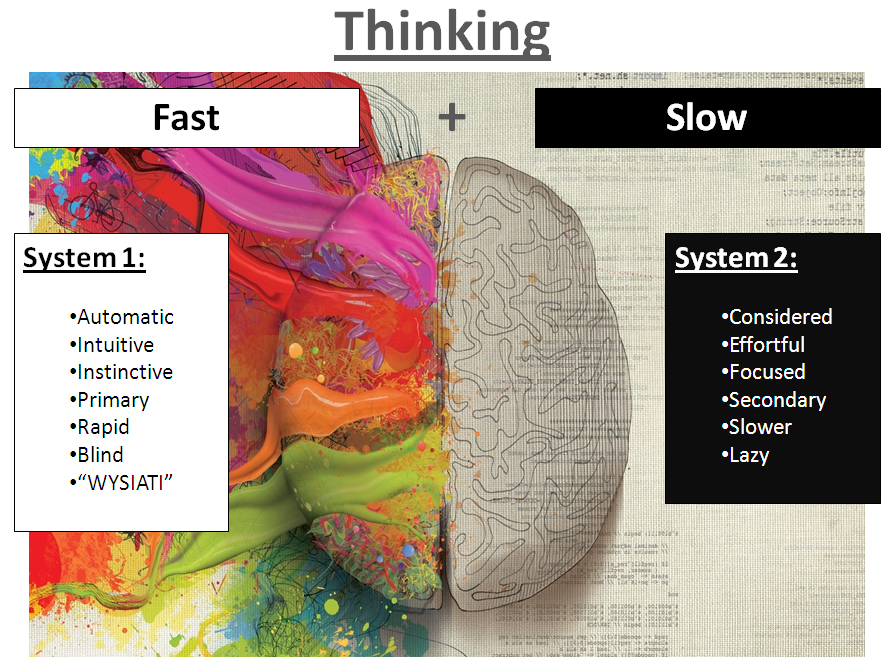
WYSIATI means "What You See is All There Is"
Daniel Kahneman had made the important discovery that we think in two distinct ways.  Kahneman points out we are generally lazy thinkers and prefer to use what he calls our System 1 thinking that looks for simplified cause and effect patterns consistent with our prior beliefs.  “System 1 is designed to jump to conclusions from little evidence"  when that evidence is consistent with our stereotypes.  System 1 is our default way of thinking and it includes a gendered ethnocentrism and identification with one's own group.  It operates mainly by associations and in frames, not by logic. It requires effort by more complex System 2 thinking to break stereotypes and most people typically would rather not put in that much work. 

For example, in several of my court cases, police officers have taken the stand to explain that a murder was committed “to advance the defendant’s status in the gang.” This sometimes makes a crime “gang-related” and eligible for enhanced penalties.  In every case of mine where this assertion was made by police, there was absolutely no evidence that “advancing in the gang” was any part of a motive.  The defendants denied it and there were no interviews with other gang members who could confirm such a dubious claim.  

Where did this imaginary but useful notion come from? From police "training" on gangs,  of course!   According to the American Prosecution Research Institute manual on gang prosecutions, such “expert” testimony by police gang squad officers "explains the inexplicable.”  In other words, a wholly made up “motive” works because it fits with juries’ stereotypes of gangs.  Juries tend to accept these allegations unconsciously through their System 1 thinking. Unless challenged, such imaginary motives are accepted as facts.

On a grander scale, Donald Trump’s unsupported claim that millions of people voted illegally fits with stereotypes of “aliens” taking advantage of "our" America. Trump repeats this lie and millions accept it by relying on the frames and confirmation bias of their System 1 reasoning.  

While Allport explained long ago that we all think in categories the content of our stereotypes largely depends on our world outlook. Many Trump supporters and the Tennessee judges, I suspect,  share what George Lakoff calls the “strict father” world view. 

The strict father outlook is fundamentally authoritarian asserting “following the rules is most important.” For my judges and millions of others, evil exists and the world is a dangerous place. The law protects us from the “other” who need to be harshly punished.   Criminals’ less-than-human status also means they are incapable of rehabilitation.  By punishing “them” we reaffirm “us,”  what Durkheim called the organic solidarity of society.  This outlook underlies our policies of mass incarceration which have put a disproportionate number of African Americans in prison.  Preserving the dominant white culture against dark-skinned threats like gangs is a core element of this view.

Gangs, to the Tennessee  judges,  are essentially evil and an insult to authority.  In a world with absolute rights and wrongs, gangs are simply wrong. Many harmful stereotypes of gangs are accepted on their face since they fit into a popular story line reinforced by prosecutors of gangs as intrinsically evil.  While gangs can be a “scapegoat” for white anxieties, a deep antipathy exists in our culture for the dark other, and gangs are a metaphor for what is perceived as an existential threat to white identity. 

The main reason I couldn’t get through to the judges was that they and I were operating within different frames and with different values. The judges never moved beyond System 1 thinking because I was unable to “reframe” my comments in ways they could understand.   While I’m sure I could have done a better job, one thing I’ve learned is that there are a large number of adherents to this hard core authoritarian outlook who cannot be won over in the short term no matter how persuasive we are.  We are literally living within different worlds and talking within different frames. Tune in to Rush Limbaugh and hear this for yourself.   Some arguments can only be won at the ballot box, in the streets, or by jury verdicts.  The courtroom, unfortunately, is an inherently unfriendly theater with the defendant playing “them” and judge, prosecutor, and jury playing “us.”

Lakoff points out all people have both strict father and what he calls nurturant parent outlooks. I’d call the two polar outlooks authoritarian and empathetic.  These viewpoints do not coincide with “left” and “right” or Democrat or Republican. Leftwing authoritarianism has been responsible for mass murders in Russia and China and is characteristic of those who exercise bureaucratic power, e.g. Michels’ “iron law of oligarchy.”  Some Christian conservatives can be deeply empathetic to the poor and the “other.”  Prosecutors claim they are empathetic to the victims of crimes, but not to offenders. 

While a minority of the population consistently holds one view or the other,  most people have elements of both. The key to persuasion of those in the middle is to activate frames based on your values that resonate with theirs.  In my final blog in this series I’ll turn to how Lakoff and others suggest we win over the undecided through an example from my court work.


Alexander, Michelle. 2010. The New Jim Crow: Mass Incarceration in the Age of Colorblindness. New York: The New Press.

Allport, Gordon W. 1954. The Nature of Prejudice. Reading, MA: Addison-Wesley.

Durkheim, Emile. 1933. The Division of Labor in Society. New York: The Free Press.

Fiske, Susan T., and Shelley E. Taylor. 1991. Social cognition. New York: McGraw-Hill, Inc.

Kahneman, Daniel. 2011. Think Fast and Slow. New York: Farrar, Strauss and Giroux.

Lakoff, George. 2004. Don't think of an elephant! : know your values and frame the debate : the essential guide for progressives. White River Junction, Vt.: Chelsea Green Pub. Co.

Michels, Robert. 1962 {1915}. Political Parties: A Sociological Study of the Oligarchical Tendencies of Modern Democracy. New York: The Free Press.

Monday, March 27, 2017

Winning over the Other Side (Part 1 of 3)

Do you think there something wrong with me? I not only read the New York Times  and listen to NPR and Democracy Now, but I also tune into to Rush Limbaugh, check  Breitbart’s website, and, gasp!, actually follow Donald Trump’s Twitter feed. 

You might diagnose masochism but I’ve long forced myself to listen to the other side. Yes, Rush Limbaugh has helped me understand why it is so hard to counter demonization of gang members in court.  

Of course I’ve found the obvious: tens of millions of people in our country live in radically different worlds.  Within these separate bubbles, people choose their media outlets, e.g. CNN, Democracy Now, Breitbart or Fox, to reinforce their pre-existing views. We are witnessing what psychologists call confirmation bias on a grand scale. While we convince ourselves we are using reason, Benferado says “really our minds are bending the facts, sawing off inconvenient corners, and tossing away contradictory information so that everything can be fit into ready-made boxes.” Not just them, us too. And unfortunately that is also how juries work.

If you encounter a fierce partisan from “the other side” on social media or in real life, you might realize it is virtually impossible to have a rational disagreement.  Sooner of later you conclude “they must be crazy,” and if you haven’t figured it out, they think the same about you.  They look only within their frame and you look only within yours.  

What is a frame? “Frames are mental structures that shape the way we see the world”, social psychologist George Lakoff says. Think of a picture frame when you focus on what is inside and pretty much ignore what is outside of it. It is what mass media do routinely, pointing your attention to one aspect to what is a more complex picture.  Lakoff (2004, 115) argues that “frames trump facts.”  He claims you cannot win an argument with facts alone, a sober realization that also applies in the courtroom. 


Frames are psychological cousins of the “social construction of reality,” a concept introduced by Peter Berger and Thomas Luckman.  In 1967 they asked philosophically (p 13), “What is real? How is one to know?” Their sociology of knowledge explains how reality becomes “institutionalized” and legitimated through secondary socialization. Today that socialization is fueled by one’s media choice. The proliferation of alternative media has led us into polarized camps, each of us drinking different flavors of cultural Kool-Aid.  Does this mean there is no “objective” reality? No, only that reality is contested.

This, of course,  brings me back to gangs.  The reason I stopped running gang programs in Milwaukee in the early 1980s was that while I directed a successful diversion program, it had no effect on what politicians or the public thought about gangs. In short, gangs were framed as evil incarnate and what the people and public officials wanted most was more police and longer prison terms. 

My solution was to do research to “reframe” the problem.  My first study, which became People & Folks,  won a front page headline in the Dec. 12, 1986 Milwaukee Journal, reframing the gang problem as a lack of jobs.   Some good that did.  Thirty years later on August 13, 2016 in Milwaukee’s Sherman Park neighborhood where I had done much my research,  gangs and other youth rioted because of lack of jobs  and persistent police brutality.  If anything has changed, it’s been for the worse. And in 2017 the mayor still wants to hire more police. I failed to change public opinion.

More recently President Trump said illegal immigrant gangs were the cause of most of the violence in Chicago. He has threatened to “bring in the feds” unless the city gets its gang problem under control.  Simply stating the facts,  like 3/4 of homicide victims and offenders are African American, not immigrants or Chicago’s homicide rate is considerably lower than the rate in Detroit or St. Louis,  is hardly persuasive.  Logic doesn’t change the beliefs of racists on the alt-right or divert Chicago’s violence-torn black community from fears of much-too-frequent violence.

This is the problem I’ve confronted in all of my gang related trials. In court, reality also has two sides: the prosecution insists the facts prove guilt; the defense says they do not.  In a trial, both the prosecution and the defense construct theories or frames that explain and dispute the facts.  Demonizing gangs and reinforcing stereotypes is a winning strategy for the prosecution, constructing frames so hard the facts will bounce off.  Thus my job as expert witness is to use research to combat stereotypes and try to reach a judge or jury.  But if disputing the facts is insufficient, what rational tools do we have to combat stereotypes?

In a trial, the defense goal is often to win over just one juror to not convict, which is much harder than it might seem. In the court of public opinion, we are looking for ways to win over millions of people who may be open to not getting on the Trump train or might want reasons to duck out.  My work in court exemplifies this problem of the limits of rationality. In my next two blogs I’d like to outline a few of my ideas on the power of stereotypes by applying concepts from the works of George Lakoff and Daniel Kahneman. Coming next week:  Two Opposed Ways of Thinking.


Benferado, Adam. 2015. Unfair: The New Science of Criminal Injustice. New York: Crown Publishers.


Berger, Peter L., and Thomas Luckman. 1967. The Social Construction of Reality. Garden City, New York: Doubleday & Company Inc. Anchor Books.

Lakoff, George.  2004. Don't think of an elephant! : know your values and frame the debate : the essential guide for progressives. White River Junction, Vt.: Chelsea Green Pub. Co.